Formula SAE is a student engineering competition where teams design, build, and race a small, open-wheel formula-style car. On paper it’s a motorsports competition. In reality, it’s one of the most intense systems-engineering learning environments you can experience as an undergraduate.
Teams are judged not just on lap time, but on:
Engineering design
Manufacturing quality
Cost and business case
Reliability and execution
The final car
Most established teams iterate year-to-year, refining designs using previous cars as testbeds. That luxury mattered a lot to us because we didn’t have it.
Formula SAE is a student engineering competition where teams design, build, and race a small, open-wheel formula-style car. On paper it’s a motorsports competition. In reality, it’s one of the most intense systems-engineering learning environments you can experience as an undergraduate.
Teams are judged not just on lap time, but on:
Engineering design
Manufacturing quality
Cost and business case
Reliability and execution
The final car
Most established teams iterate year-to-year, refining designs using previous cars as testbeds. That luxury mattered a lot to us because we didn’t have it.
One F1 Obsession and One Physics Brain
The project started with a friend of mine who was, in the best possible way, an F1 obsessive. He didn’t just watch Formula 1, he lived it. Telemetry, suspension geometry, aero trade studies, team politics. All of it.
I came from a different angle. I loved the physics: fluid flow, dynamics, structures, control. Formula SAE immediately struck me as the ultimate forcing function: a way to turn abstract coursework into something brutally real.
Together, we convinced our university to approve Formula SAE as a senior capstone project. That approval came with a modest budget and, more importantly, legitimacy. By the end, about 20 undergraduate students were involved in designing, building, testing, and driving the car.
A Lens for Learning
I easily spent twice as much time on Formula SAE as on all my coursework combined and it paid off in ways no class ever could.
Every new concept suddenly mattered:
Fluid flow → intake and cooling
System dynamics → suspension and driveline
CAD → everything
Design for manufacturing → everything again
Kinematics → suspension geometry
Instrumentation → testing and debugging
Statistics → data interpretation
FEA and CFD → structural and aero intuition
Optimization → tradeoffs everywhere
Formula SAE gave me a lens. Instead of learning topics in isolation, every lecture felt like it could help make a better race car.
CAD First, Simulation Later (If Ever)
We realized very quickly that CAD was non-negotiable. Everything had to fit. Everything interacted. Everything had consequences.
The car’s structure was designed entirely by students, balancing stiffness, mass, manufacturability, and safety.
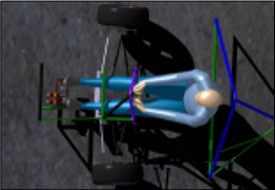
Early CAD rendering of the Formula SAE car, showing chassis layout, suspension geometry, and packaging constraints
Refined CAD model incorporating lessons learned from the prototype build and early testing
We used finite element analysis selectively, not to chase perfect stress predictions, but to identify load paths, calculate stiffnesses, and filter out bad design concepts.
Finite element analysis of press-fit titanium axle into an aluminum upright under cornering load
Simulation was a guide, not a crutch.
What we couldn’t do, at least not well, was simulate the full system. About 90% of the teams we competed against had previous cars to validate models against. We had nothing.
So we made a counterintuitive decision.
Two Cars, Not One
Instead of betting everything on a single “perfect” design, we committed to building two cars.
A rough prototype car
A refined final competition car
We started in September and set an aggressive internal deadline:
The first car would drive under its own power by January 1.
We missed that deadline by three days but on January 4, the prototype rolled under its own power.
Well, more than rolled
That moment changed everything. Suddenly we had:
A testbed
Real data
Real failures
Real intuition
Everything we learned went directly into the final car.
Driving the Thing
I only drove the car once.
It was… violent.
0–100 km/h in about 3 seconds
More than 1 g lateral acceleration
The driver wasn’t so much sitting as lying down to keep the center of gravity low
My shoulders were a few centimeters from the exhaust headers
They were red for days afterward.
It was raw, loud, uncomfortable, and absolutely unforgettable.
Results and Trajectories
That year, we won Formula SAE Rookie of the Year.
But the bigger outcome was personal trajectory.
My friend went on to work for several F1 teams over the years (another story for another day)
I went to graduate school to learn combustion and how to design real experiments
For me, Formula SAE permanently set the direction:
taking ideas from my head,
turning them into models and mockups,
and then building hardware that actually works
Why It Still Matters
That project taught me something I still rely on today:
You don’t learn engineering by avoiding complexity.
You learn it by confronting complexity early, imperfectly, and honestly.
Formula SAE wasn’t just a car.
It was the moment engineering stopped being theoretical for me, and started being real.
Ryan Blanchard PhD
Design, Research, Engineering, Data, Physics. I believe that few things in life are as rewarding as commiting yourself to a project to get something built. The feeling of seeing numerical and statistical models come to life in real-world hardware is just unbeatable.
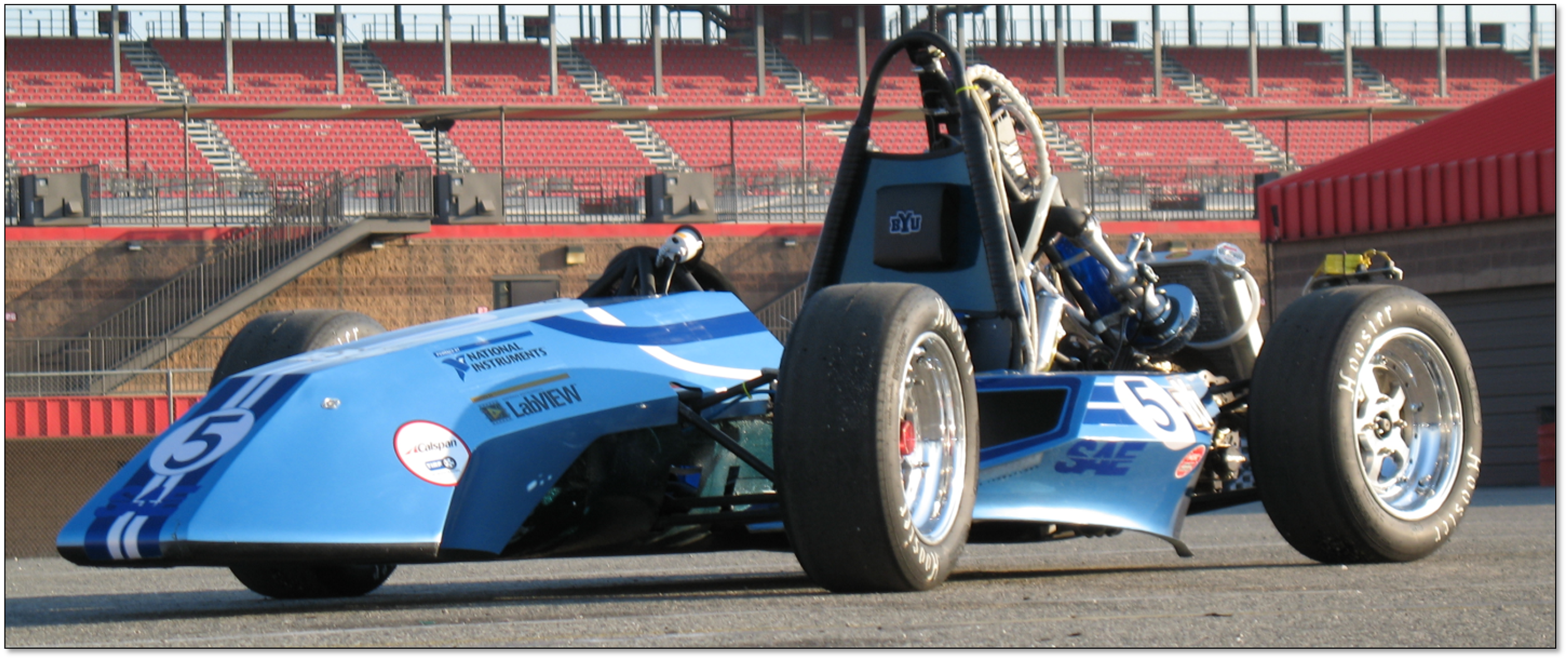 The final car
 Early CAD rendering of the Formula SAE car, showing chassis layout, suspension geometry, and packaging constraints
 Refined CAD model incorporating lessons learned from the prototype build and early testing
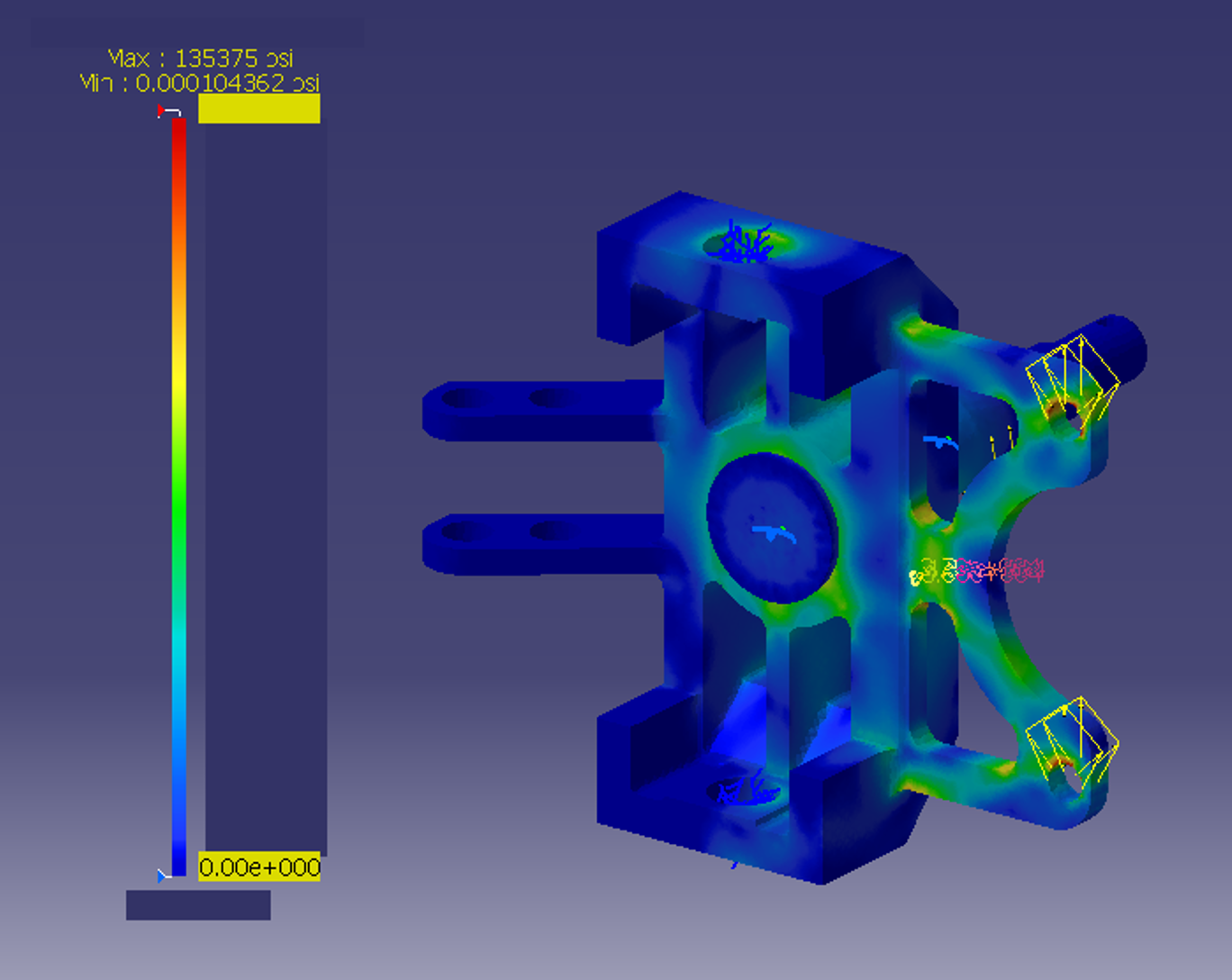 Finite element analysis of press-fit titanium axle into an aluminum upright under cornering load