Afterburners live in a difficult corner of fluid mechanics: high-speed turbulent flow, intense heat release, strong recirculation, and unsteady pressure coupling. A flameholder has to do two contradictory things at once:
Create a stable recirculation zone to anchor a flame
Do as little damage as possible to pressure recovery and thrust
For vee-gutter bluff-body flameholders, stability comes from the wake. Hot combustion products recirculate behind the gutter, ignite incoming reactants, and sustain a flame even when residence times are extremely short. The same wake, however, is inherently unsteady and sheds vortices that can couple to acoustics and... read more
PhD Thesis: Afterburner Flame Dynamics
4 minute read
Why Afterburners Are Hard
Afterburners live in a difficult corner of fluid mechanics: high-speed turbulent flow, intense heat release, strong recirculation, and unsteady pressure coupling. A flameholder has to do two contradictory things at once:
Create a stable recirculation zone to anchor a flame
Do as little damage as possible to pressure recovery and thrust
For vee-gutter bluff-body flameholders, stability comes from the wake. Hot combustion products recirculate behind the gutter, ignite incoming reactants, and sustain a flame even when residence times are extremely short. The same wake, however, is inherently unsteady and sheds vortices that can couple to acoustics and lead to thermoacoustic instabilities.
Understanding how that wake behaves and whether simulations reproduce it for the right reasons was the central motivation of my PhD.
What My Thesis Set Out to Do
Most combustion simulations are “validated” using time-averaged quantities: mean velocities, RMS fluctuations, or single-point spectra. Those metrics are necessary, but they are not sufficient for unsteady reacting flows.
This work asked a more demanding question:
Can we validate simulations based on the structure and dynamics of the dominant flow and heat-release modes?
To answer that, I designed and built a dedicated afterburner-scale experiment and paired it with Large Eddy Simulations (LES). Proper Orthogonal Decomposition (POD) was then used as the common language between experiment and computation.
The Experimental Rig
The experimental setup was built from scratch in the Combustion Systems Dynamics Lab at Virginia Tech. It consisted of:
A modular fuel-injection section
A long converging section to control boundary-layer development
A rectangular test section with optical access
A 70° vee-gutter flameholder spanning the duct
High-speed diagnostics included:
Stereo Particle Image Velocimetry (PIV) for velocity fields
Filtered chemiluminescence imaging as a proxy for heat release
The rig was designed to operate in both non-reacting (cold-flow) and reacting regimes, allowing a controlled progression from pure fluid mechanics to fully coupled combustion dynamics.
Large Eddy Simulation
On the computational side, LES models were developed in both ANSYS Fluent and OpenFOAM, matched as closely as possible to the experiment.
At the heart of LES is a spatial filtering of the Navier–Stokes equations:
Unresolved turbulence was modeled using dynamic Smagorinsky-type closures, with grid resolution chosen so that the majority of turbulent kinetic energy was resolved rather than modeled.
A key validation criterion was the Pope criterion, ensuring that modeled subgrid energy remained a small fraction of the resolved energy:
$$
M = \frac{k_{\text{sgs}}}{k_{\text{resolved}}} \lesssim 0.2
$$
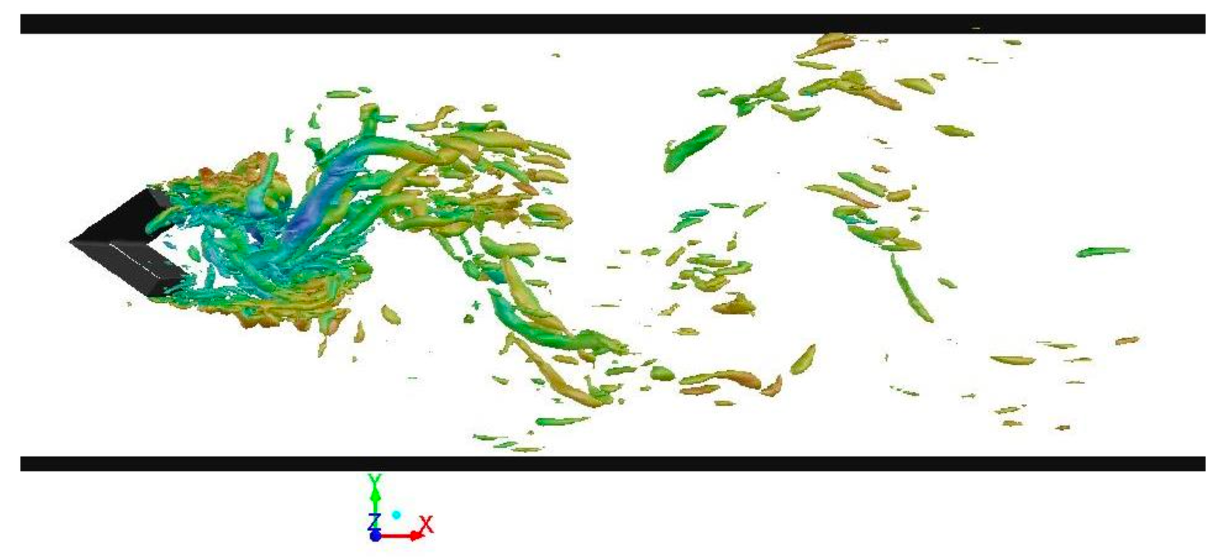
Instantaneous LES velocity magnitude showing alternating vortex shedding
Proper Orthogonal Decomposition (POD)
POD provided the bridge between experiment and simulation.
Given a set of instantaneous snapshots assembled into a data matrix $ \mathbf{U} $, POD seeks a low-dimensional representation:
Each mode represents a coherent physical structure
Crucially, POD is agnostic to data source. Experimental measurements and LES fields can be decomposed and compared mode-by-mode.
Cold Flow: Wake Dynamics
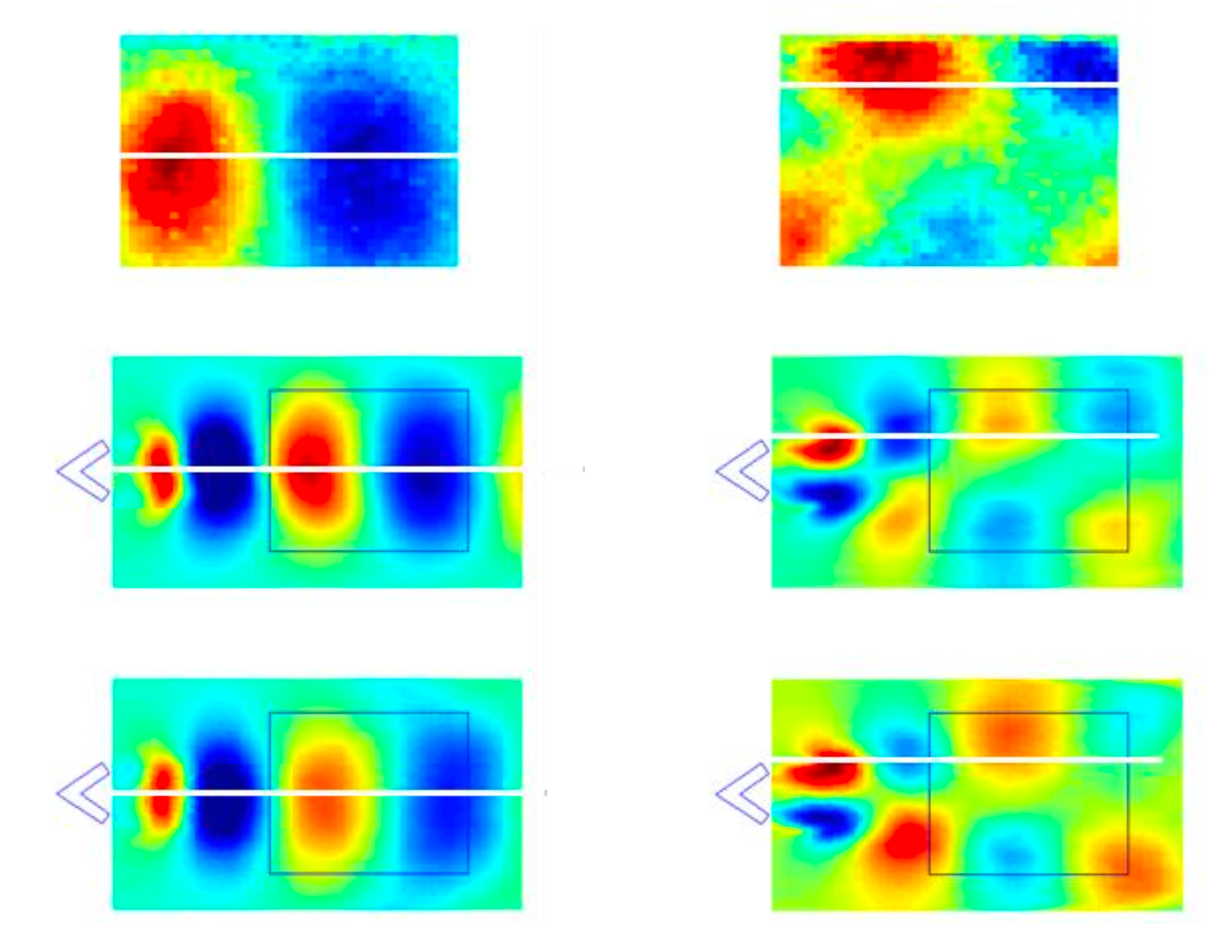
In the non-reacting case, POD isolated the dominant vortex-shedding mode of the vee-gutter wake. The shedding frequency collapsed to a Strouhal number of approximately:
$$
\mathrm{St} = \frac{f w}{U} \approx 0.24
$$
The first POD modes from PIV, Fluent, and OpenFOAM showed strong agreement in:
Spatial structure
Amplitude
Streamwise evolution
This went well beyond matching mean velocity profiles and demonstrated that the simulations were capturing the right physics of the wake.
POD modes of the cold flow PIV data (top row) and CFD simulations (Fluent middle OpenFOAM bottom)
Reacting Flow: Heat Release Dynamics
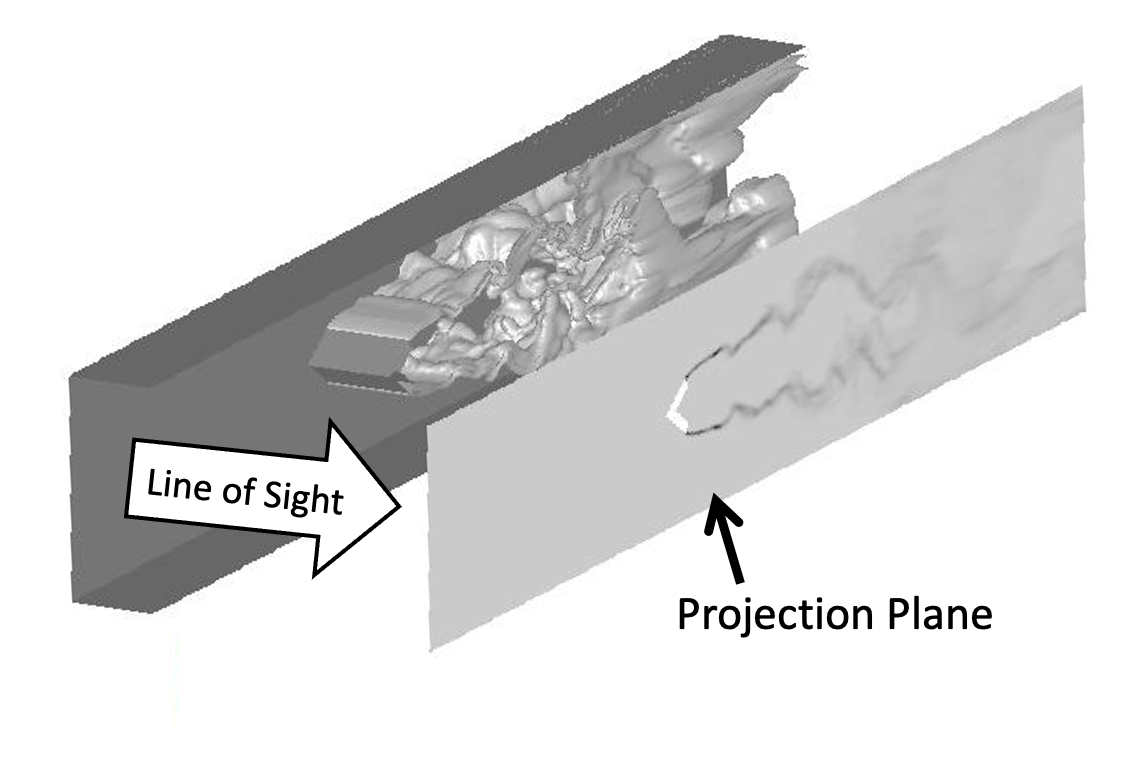
For reacting cases, validation became more subtle. Chemiluminescence measurements are line-of-sight integrals, while LES produces local volumetric heat release.
To make the comparison meaningful, the LES heat release was integrated numerically along synthetic lines of sight:
Instantaneous heat flame sheet left with integrated heat release “image” on the left
fig4-flameprojection.png
$$
I(x,y) = \int \dot{q}^{'''}(x,y,z) \, dz
$$
Animation of the simulated flame (left) and the integrated heat release image $I(x,y)$ on the right
POD of these integrated fields revealed:
A dominant symmetric shedding mode
Higher-frequency harmonic modes
A low-frequency, low-energy mode invisible to time-averaged analysis
The agreement in mode shape, frequency, and relative energy between experiment and LES provided strong evidence that the simulations were dynamically faithful.
POD modes of the heat release chemiluminescence data (left) and CFD simulation in Fluent (right)
Why This Matters
The most important outcome of this work was methodological.
By validating dynamic modes, not just statistics, we gain confidence that LES models can be trusted to explore:
Confinement effects
Boundary condition sensitivity
Transitions between symmetric and asymmetric flame dynamics
This is essential for predicting combustion instability risk, flameholder performance, and operability limits in real engines.
So What?
My PhD sat deliberately at the intersection of design, experiment, simulation, and data-driven analysis. Building the hardware mattered. Writing the solvers mattered. But the real leverage came from learning how to ask better validation questions.
That mindset: validating structure, not just numbers, continues to shape how I approach complex engineering problems today.
Ryan Blanchard PhD
Design, Research, Engineering, Data, Physics. I believe that few things in life are as rewarding as commiting yourself to a project to get something built. The feeling of seeing numerical and statistical models come to life in real-world hardware is just unbeatable.
 Instantaneous LES velocity magnitude showing alternating vortex shedding
 POD modes of the cold flow PIV data (top row) and CFD simulations (Fluent middle OpenFOAM bottom)
 Instantaneous heat flame sheet left with integrated heat release “image” on the left
fig4-flameprojection.png
Instantaneous heat flame sheet left with integrated heat release “image” on the left
fig4-flameprojection.png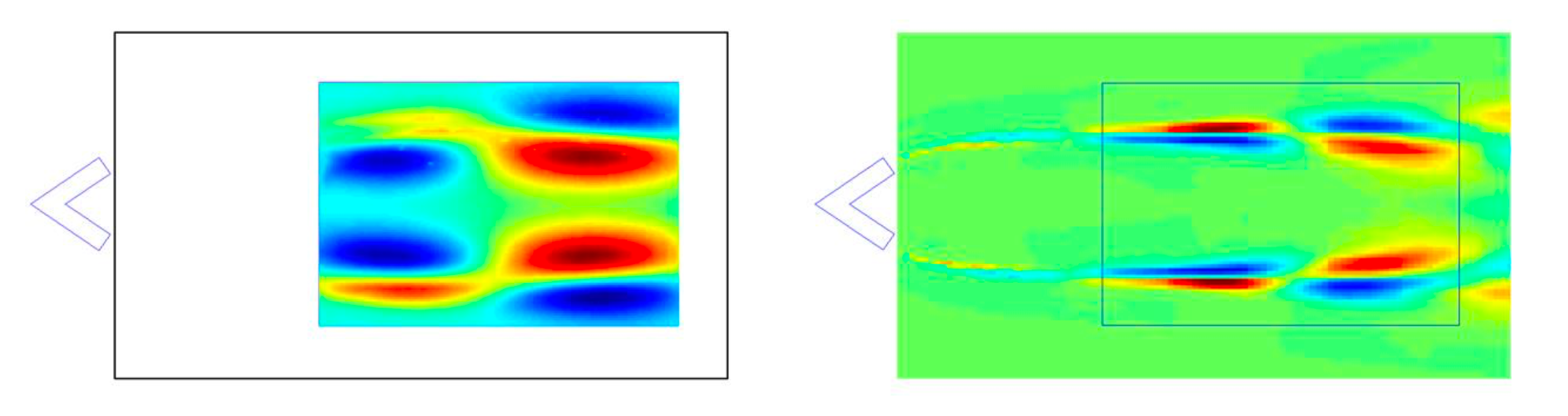 POD modes of the heat release chemiluminescence data (left) and CFD simulation in Fluent (right)